

I should say up front that I am not a natural judge of hotel rooms. Put me in front of a minibar and I will spend a worrying amount of time deciding whether the little bottle of raki counts as room service or larceny. So when I tell you that Arte Cave Hotel has thirteen rooms and no two of them are quite the same, understand that I only worked this out by getting lost in the building four separate times, each time emerging into a slightly different cave than the one I’d left, like a man repeatedly failing the same simple maze.
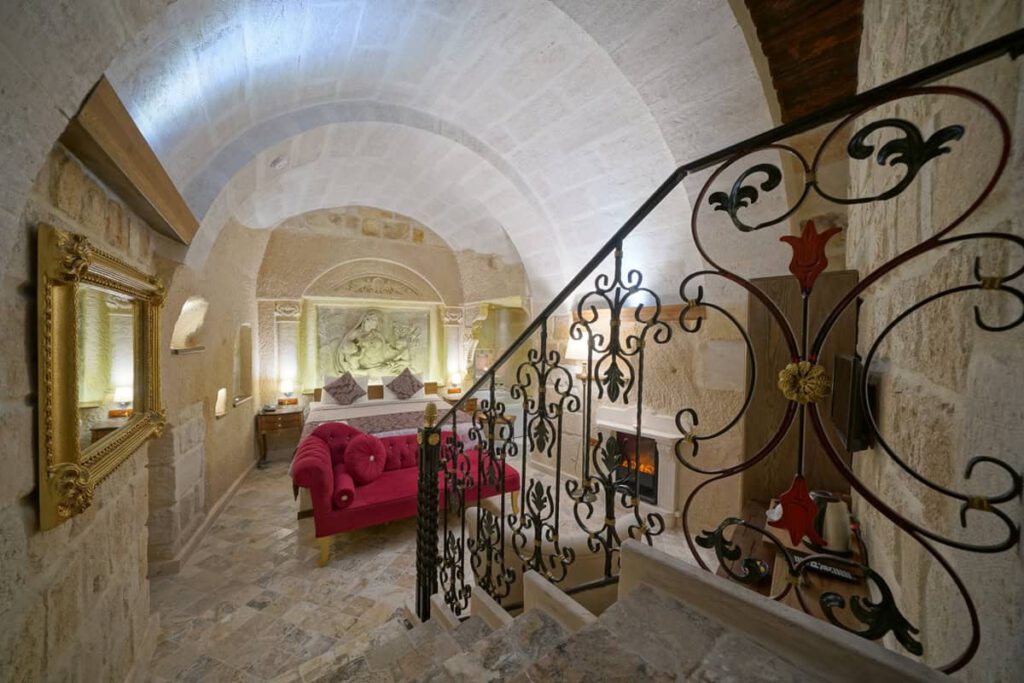
This, it turns out, is rather the point. The rooms here are carved into the same volcanic rock that makes up half of Cappadocia’s postcards, which means the hotel didn’t so much design thirteen rooms as discover them, the way you might discover that the awkward cupboard under your stairs is actually a perfectly good place to put a bed, if you squint and lower your expectations for headroom. Some are broad and vaulted with ceilings like the inside of a very calm whale. Others are snugger: the kind of room where you can start the coffee machine and touch the opposite wall without getting out of bed, which some people would call cramped and I choose to call efficient.
What follows is a genuine attempt to describe all thirteen honestly, room by room, because I have stayed in enough hotels where the website shows you one photogenic suite and lets you assume the other twelve look the same. They don’t. They really don’t. Here they are.
The Six Rooms With a Jacuzzi
Six of the thirteen rooms come with a private jacuzzi, and I want to be honest about what happens the first time you encounter one tucked into a corner of solid rock: you assume it’s decorative. Surely, you think, they can’t actually fill this thing with hot water without the whole hillside developing opinions about it. They can. It works. I stood in mine for a full minute the way you might stand in front of a magic trick, waiting for the part where it goes wrong. It never came.
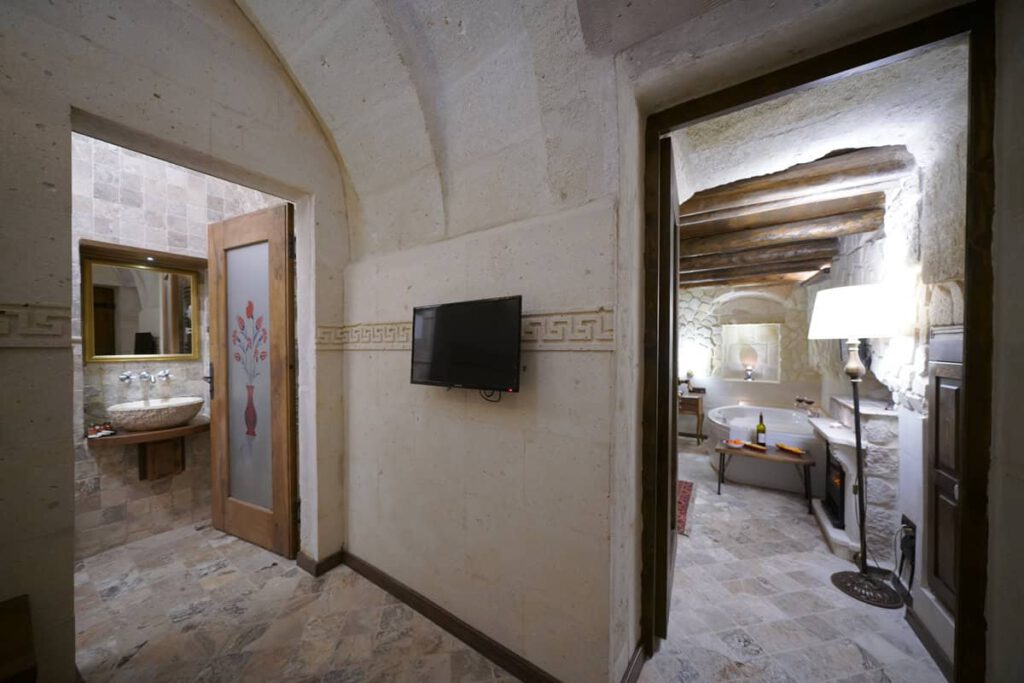
Room 101, the Triple Cave Room, is the largest of the jacuzzi rooms at 26 square metres, and the only one built for three: a queen bed plus a separate twin, which is either a lovely arrangement for a small family or a mildly awkward one for a honeymoon that’s acquired a third wheel. Either way, it’s got the most floor space of any jacuzzi room to spread out in, and a jacuzzi large enough that you stop feeling self-conscious about how long you’ve been sitting in it.
Rooms 103, 105, and 106 are the Deluxe Honeymoon Cave Rooms, each somewhere between 20 and 25 square metres, each with its own particular arrangement of stone archways that no amount of interior design training could have produced on purpose: the kind of asymmetry you only get when the room used to be, several centuries ago, whatever the room needed to be that week.
All three come with a jacuzzi tucked into an alcove, and all three have slightly different personalities depending on which way the original cave happened to curve. I couldn’t tell you which of the three is “best.” I can tell you that in all three, I found myself talking to the ceiling at one point, out of pure appreciation, which is not something I do in ordinary rooms with ordinary ceilings.
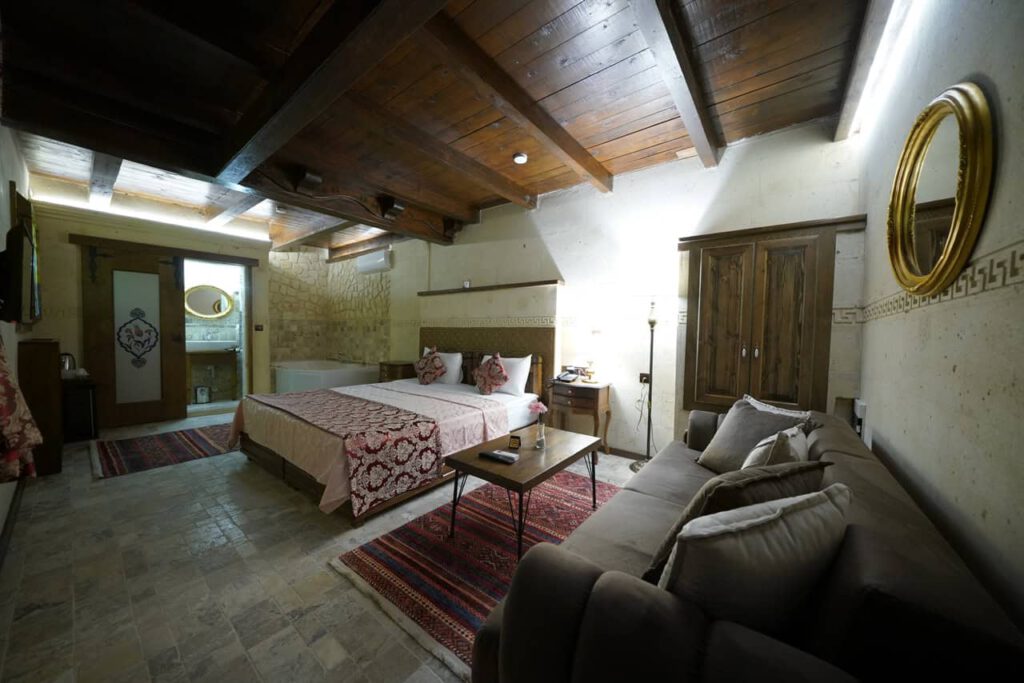
Room 202, the Honeymoon Stone Room, plays the same trick in carved stone rather than cave rock, which sounds like a small distinction and isn’t. Stone rooms tend to feel a touch more structured, more deliberately built, where the cave rooms feel found. At 28 square metres it has real room to breathe, and if you’re choosing between a cave suite and a stone suite for a honeymoon on the strength of photographs alone, I’d say: pick whichever one made you say “oh” out loud. That’s the right one.
Room 108, the Deluxe King Room, is the biggest room in the entire hotel at 30 square metres, built around an arched stone ceiling and, again, its own jacuzzi. This is the room for people who have decided that if they’re going to have a hole in a mountain, it might as well be the largest available hole in the mountain. I have no further notes on Room 108 except that I resented having to check out of it, which I suppose is the whole review in one sentence.
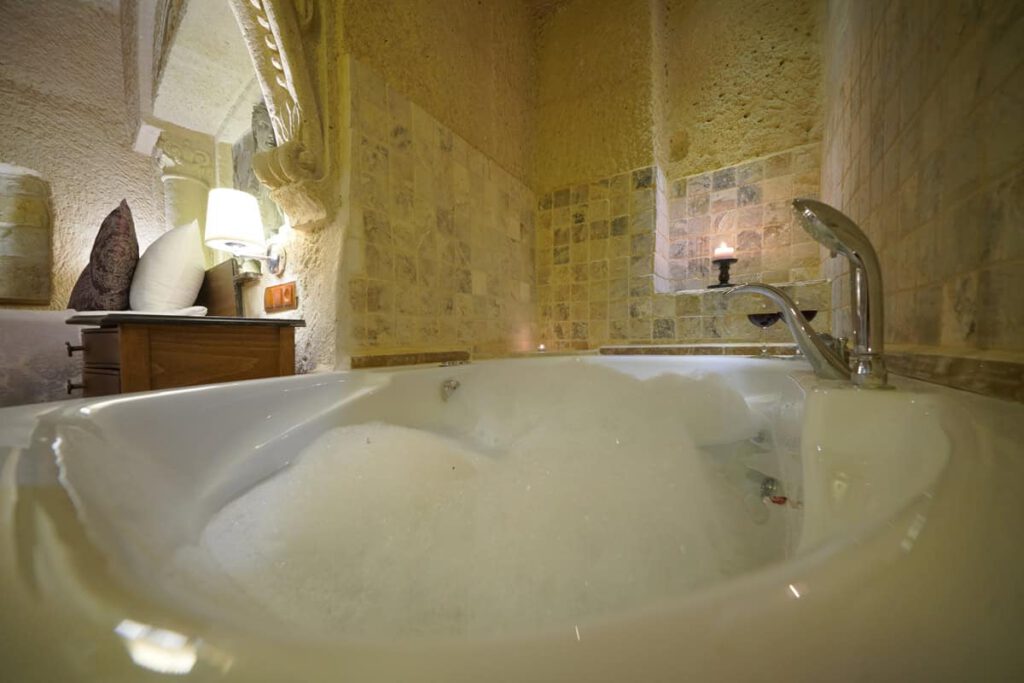
All six jacuzzi rooms come with the same practical furniture of modern travel: minibar, kettle, tea and coffee things, a hairdryer that, like all hotel hairdryers, seems to have been designed by someone who has never personally dried hair, a television, air conditioning, and Wi-Fi that mostly reaches. All six also come with the option of a paid airport transfer, which I would take you up on, because I once tried to work out Nevşehir’s taxi arrangements on no sleep and several hours of jet lag, and it did not go well for either of us.
The Family Room
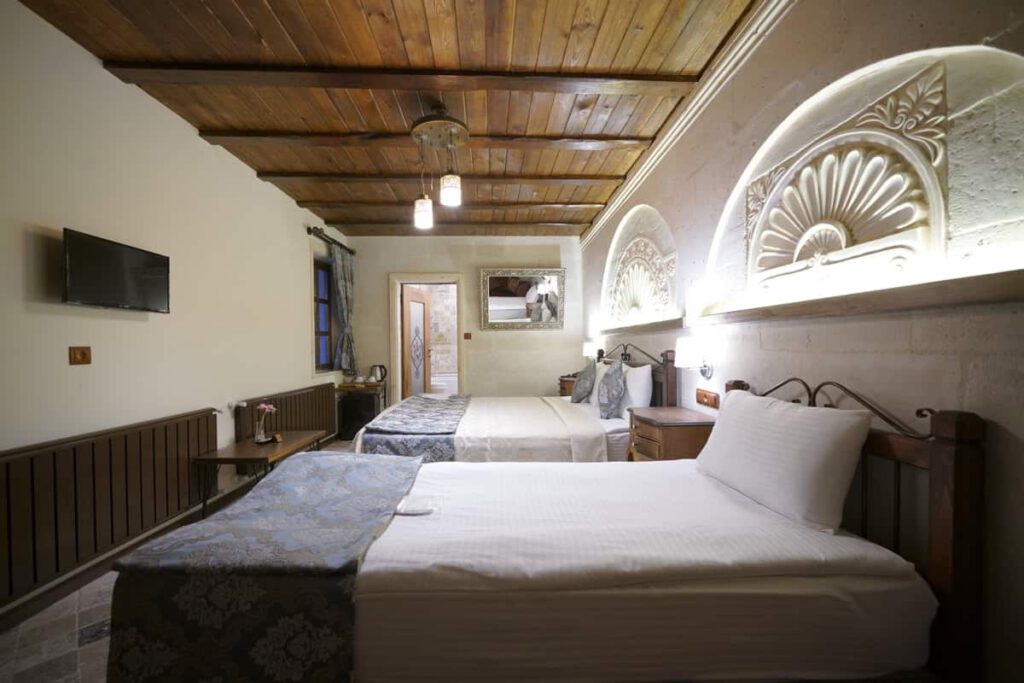
There is exactly one dedicated family room, 109, the Stone Family Room, and it deserves its own heading because fitting four people into a cave without anyone waking up entangled with a sibling is a genuine feat of architecture. At 28 square metres it’s roomier than most of the standard rooms, built around the idea that somebody, somewhere, is traveling with children who need their own corner to sulk in, and a parent who needs a door that closes. It sleeps up to four, which in my experience of family travel means it comfortably sleeps two adults and technically sleeps two children, who will in practice end up in the parents’ bed by 4 a.m. regardless of how many beds you book. The room cannot solve that. No room can. But it can at least give everyone somewhere to start the night.
The Standard and Classic Rooms
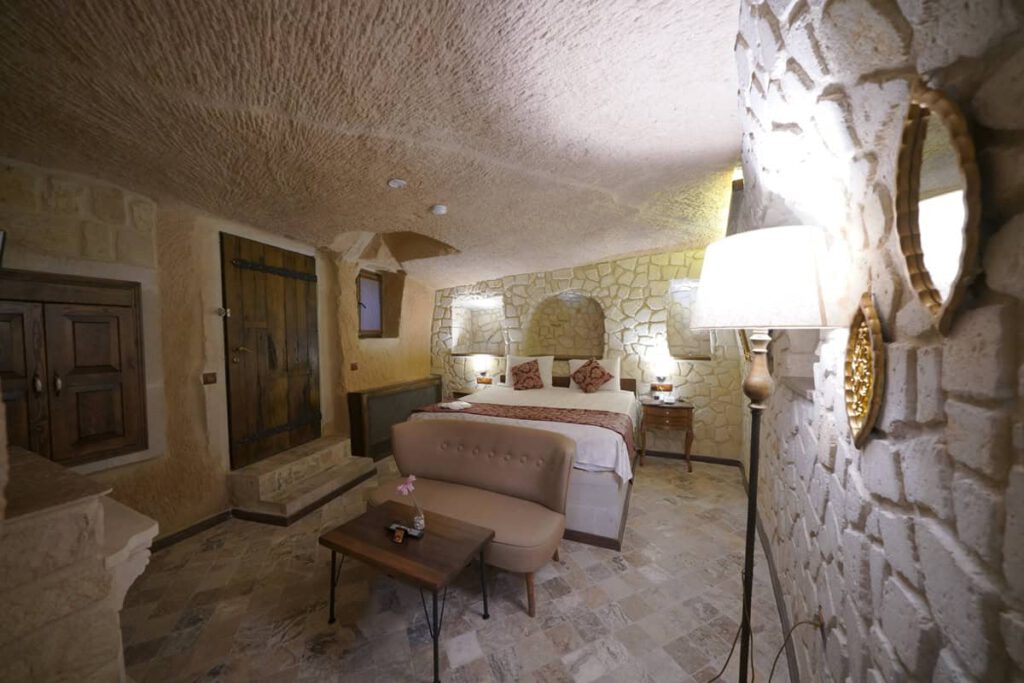
The other six rooms are smaller, simpler, and, I’d argue, no less charming for skipping the jacuzzi. They range from a cosy 11 square metres up to 18, and what they lack in bath-based drama they make up for in being exactly what a cave or stone room ought to be: thick walls, a proper bed, somewhere to put your bag, and a silence so complete you can hear yourself deciding whether coming here was a good decision or not. (It was.)
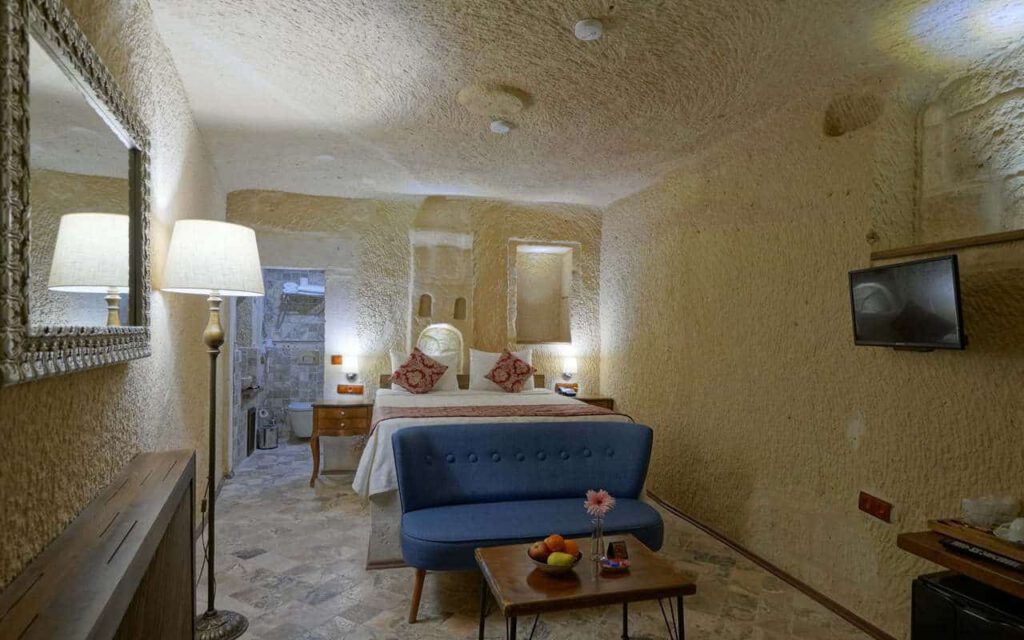
Rooms 102 and 104 are both Standard Cave Rooms (14 and 18 square metres respectively), built into the rock in the same style as their jacuzzi-equipped neighbours, just without the jacuzzi and, accordingly, at a friendlier rate.
Room 107, the Twin Stone Room, is the smallest room in the hotel at 11 square metres, arched and snug, and suits either a solo traveler who doesn’t need much square footage to be happy, or a couple who genuinely like each other enough not to need any distance between the beds.
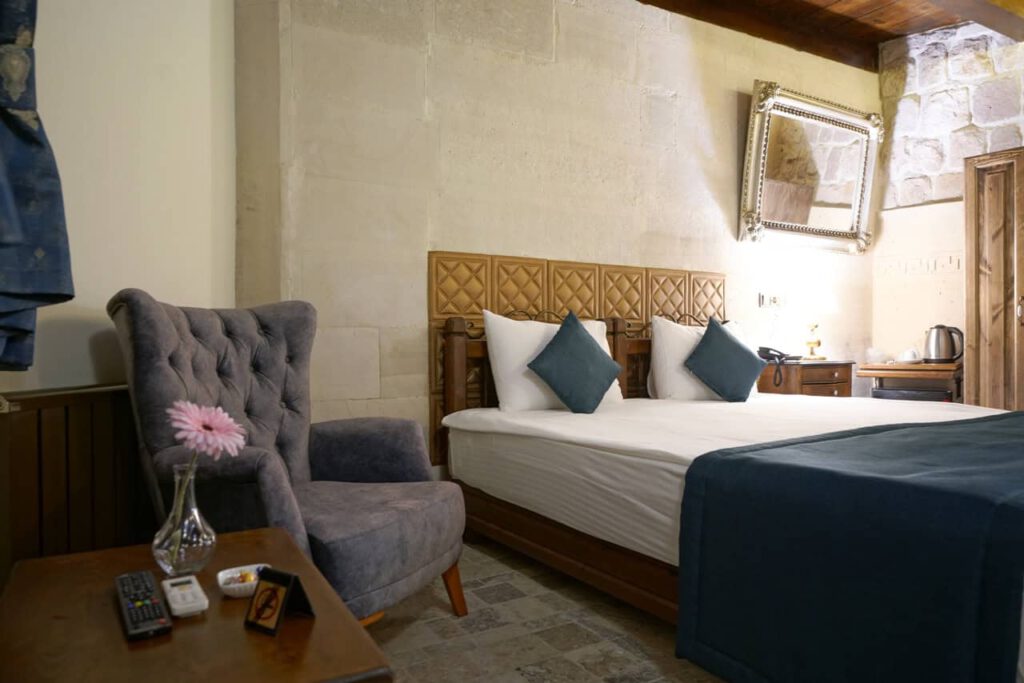
Room 201, the Standard Stone Double, and Room 203, the Classic Stone Room, are both 17 square metres and both carved from stone rather than the softer cave rock: a slightly cooler, more architectural feel, if that distinction means anything to you before you’ve stood in one.
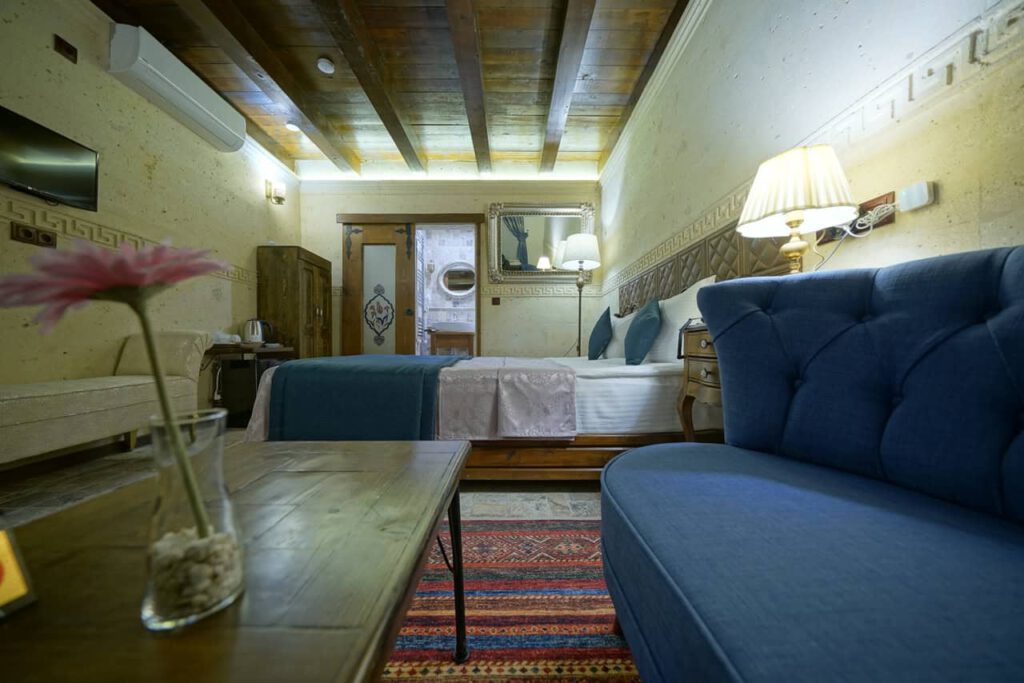
Room 204, the Standard Double Room, rounds out the group at 18 square metres, plain, comfortable, and entirely unbothered by not being the honeymoon suite.
A brief and unnecessary digression about ventilation
Here is a thing nobody warns you about volcanic rock: it holds its temperature with a stubbornness that would be admirable in a person.
Every room, whatever its size, benefits from walls that stay cool in a way that has nothing to do with air conditioning and everything to do with several thousand years of geological patience. I spent one entire afternoon in Room 105 convinced my room had some kind of secret climate control system humming away behind the walls, before realizing the secret climate control system was, in fact, the mountain, which had been quietly doing this job since long before anyone thought to put a bed in it. I have never felt more thoroughly out-engineered by a rock, and I include in that comparison several actual engineers I have met.
The same stubbornness that keeps the rooms cool in summer works in your favour in winter too: the rock holds its roughly 16-to-17-degree temperature regardless of the season, so on a cold morning the room actually feels mild and generous by comparison to whatever’s happening outside, rather than slow to catch up. It isn’t a case of waiting the room out. It arrives at that temperature and stays there, which, frankly, is more discipline than I can say for most hotel heating systems I’ve had to make peace with.
Which room, then?
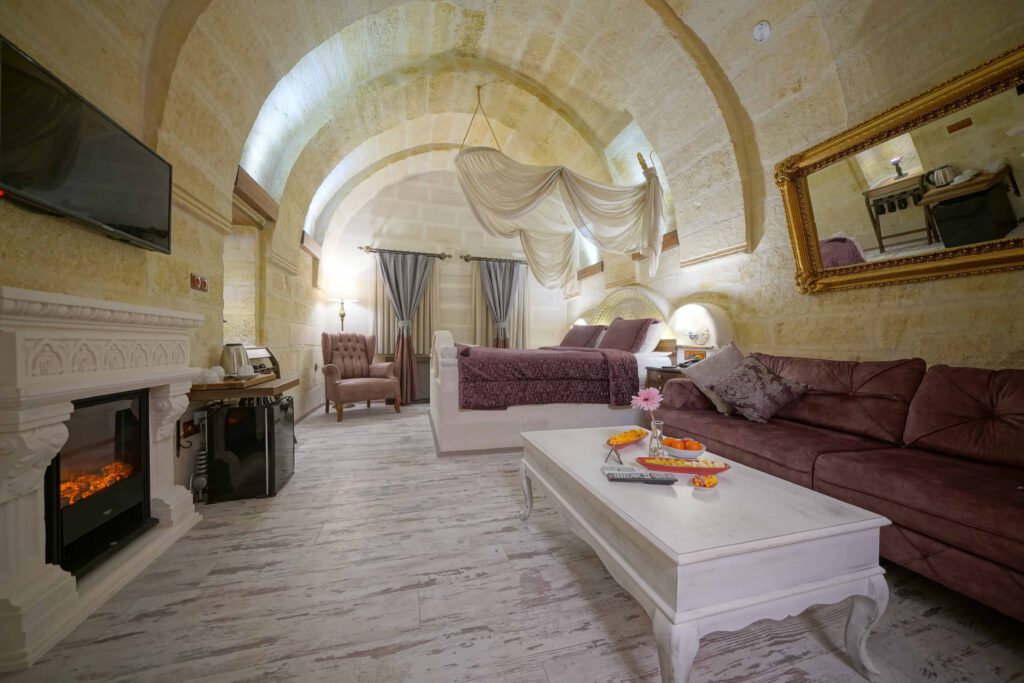
If you’re here for the occasion (an anniversary, a honeymoon, the kind of trip you’ll bring up unprompted for the next decade), one of the six jacuzzi suites is the obvious answer, and Room 108 if you want the most space to be dramatic in, or 103, 105, or 106 if you want the classic cave-suite arch overhead while you’re being dramatic.
If you’re travelling as a family, 109 is built for exactly that and nothing else. And if you’d rather skip the fuss and the jacuzzi, any of the six standard or classic rooms will do the job perfectly well at a friendlier price, and you’ll still spend your first ten minutes running a hand along the wall in quiet disbelief that a hotel room can also, somehow, be a piece of the mountain.
You can check live availability and current rates for all thirteen rooms on our booking page, or browse the full room list on the homepage to see photos of each one before you decide. Whichever you choose, you’ll be sleeping in something that was here before the hotel, before the road outside, and, I’d guess, though nobody’s confirmed this for me, before most of what you’d consider history. That’s a strange thing to fall asleep next to. It’s also, I found, a very good one.
Related reading: Honeymoon in Cappadocia: our jacuzzi cave suites for two · Amenities & services at Cappadocia hotels.
Bu sayfayı Türkçe okuyun · Leer esta página en español
Written by the team at Arte Cave Hotel, hoteliers based in Ürgüp, Cappadocia, drawing on firsthand local experience.